
Is It Legal to Record Phone Calls? A 2026 State-by-State Guide
Table of Contents
The short answer: under US federal law, you can record a phone call as long as at least one person on the call consents — and that one person can be you. The long answer has twelve exceptions, a handful of penalties that run to five figures per call, and a stack of practical complications that catch out most people who try to handle this informally.
If you are running an AI phone agent, a customer service line, a sales operation, or any business that handles calls, the call recording rules matter. They are not optional. This article walks through the federal baseline, the state variations, the rules for cross-state calls, and the specific implications for AI phone agents that record and transcribe every conversation by default.
The federal baseline: one-party consent
Under federal law — specifically 18 U.S. Code § 2511 — it is illegal to intentionally intercept, record, or disclose any wire, oral, or electronic communication without consent. The word that matters is “consent.” The federal rule is that one party to the conversation has to consent, and that party can be you. If you are a participant on the call, you can record it without telling the other person, under federal law.
This is called one-party consent. It is the default in most states, and it covers the majority of US business call recording that happens every day — customer support calls, sales calls, interviews, anything where one of the parties on the line has decided to hit record.
The federal penalty for illegal recording runs up to five years of imprisonment and significant fines. Civil damages are also available to the party whose call was illegally recorded. This is rarely enforced against private individuals for personal recordings, but it is regularly enforced against businesses that mishandle call data at scale.
The twelve all-party consent states
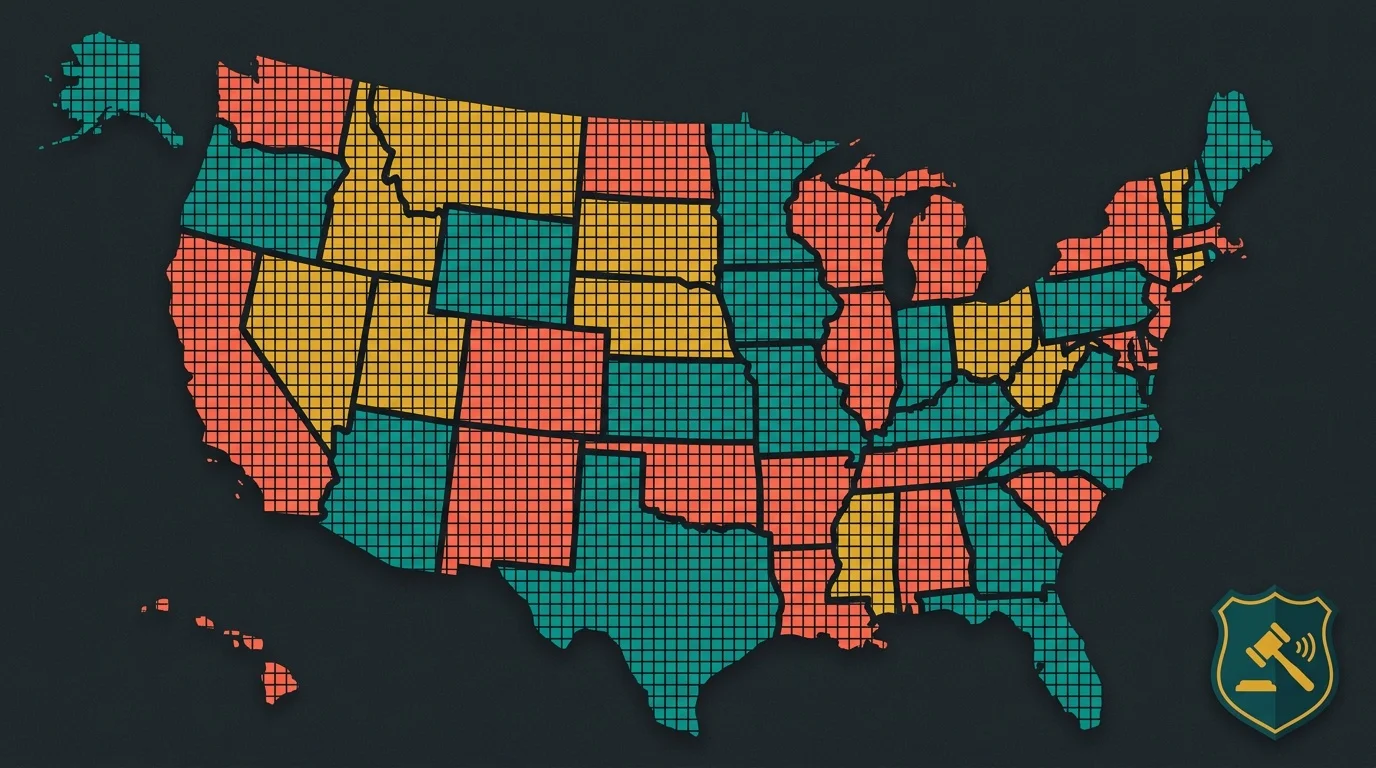
Twelve US states impose a stricter rule: every party on the call must consent to the recording. These are commonly called “two-party consent” states, which is a bit misleading — if there are three people on a call, all three must consent. “All-party consent” is more accurate.
The twelve all-party consent states as of 2026 are:
The remaining 38 states and the federal government follow one-party consent, though some of them have additional wrinkles around business recording, announced recording, or recording of specific types of calls (like those involving minors).
The rule for calls that cross state lines
This is where most people trip up. If you are calling someone in California from a one-party-consent state like Texas, which law applies?
The safe answer, and the answer every compliance professional will give you: apply the stricter rule. If any party to the call is in an all-party consent state, you should assume all-party consent is required. California courts have explicitly held that California's all-party consent rule applies to calls into California from other states, and other all-party consent states have taken similar positions. The cost of getting this wrong is high, and the solution is cheap — just announce the recording at the start of every call.
For AI phone agents that handle interstate traffic, this essentially means you default to announced recording for every call. It is simpler, it is safer, and it is what almost every serious commercial deployment does.
How to announce recording correctly
If you are going to announce the recording on every call, the announcement itself needs to meet the legal requirements. Courts in all-party consent states have been specific about what counts.
The announcement must be clear and understandable. A mumbled “this call may be monitored” at the very end of a long disclaimer does not count. The caller should actually hear and comprehend that the call is being recorded.
The announcement must come before recording begins. You cannot record the opening of the call and announce it after the fact. Most business phone systems handle this automatically by starting the recording only after the disclaimer has played.
The caller's continued participation must constitute consent. The standard pattern is: “This call may be recorded for quality and training purposes. If you do not wish to be recorded, please let me know.” Callers who stay on the line and keep talking have implicitly consented. Callers who object have to be given a non-recorded path, which usually means transfer to an agent with recording disabled.
The announcement language should name the purpose. Vague recording disclaimers have been challenged in court. Specific ones (“recorded for quality and training purposes,” “recorded for accuracy of order entry”) are more defensible. For AI phone agents, “this call may be recorded and transcribed by an automated system” is a reasonable formulation.
What “recording” actually means
One complication that specifically affects AI phone agents: the definition of recording in most state statutes predates the era of automatic transcription. A call that is transcribed in real time but where the audio is not retained is still creating a record of the conversation, and several states have applied their recording statutes to transcripts as well as audio files.
The practical interpretation for AI phone agents: if you are going to produce a transcript or store call metadata, treat that the same way you would treat an audio recording for consent purposes. Announce at the start of the call. Apply the stricter state's rule. Do not rely on the technical distinction between “recording audio” and “generating a transcript” — the courts have not been sympathetic to that distinction and the statutes are broadly written.
This is why most commercial AI phone agents disclose recording and transcription in their opening statement regardless of the caller's state. The alternative is building a state-detection layer that decides in real time whether to record, which is more complexity than it is worth for a negligible cost savings.
Special rules for specific call types
Some call types have additional rules that override the general state-by-state framework.
Financial calls. The FDCPA (Fair Debt Collection Practices Act) imposes specific disclosure rules on debt collectors, and the CFPB has issued additional guidance on call recording by regulated financial institutions. These rules can be stricter than the underlying state law.
Healthcare calls. HIPAA does not directly prohibit recording, but any call involving protected health information has to be handled in compliance with HIPAA's privacy and security rules — which includes appropriate retention, access controls, and breach notification for any call data that becomes a record. For AI phone agents in healthcare, the recording question is subordinate to the broader HIPAA compliance question.
Attorney-client calls. Attorney-client privilege attaches to communications between lawyer and client for the purpose of seeking legal advice. Recording such a call does not necessarily break privilege, but introducing a third-party recording system into the conversation can waive privilege in ways that are expensive to litigate. Most law firms avoid recording client calls entirely for this reason.
Calls involving minors. Several states impose heightened requirements on recording calls with minors, including enhanced consent standards and restrictions on retention. Check state rules before deploying any automated system that may handle calls involving minors.
What this means for AI phone agents specifically
For an AI phone agent that records and transcribes every call by default, the practical checklist is short:
- Announce recording at the start of every call, in clear English. Not buried, not optional. The standard form works: “This call may be recorded and transcribed for quality and service purposes.”
- Apply the stricter state's rule when in doubt. Default to all-party consent behavior for interstate traffic.
- Offer a non-recorded path for callers who object. This is usually a transfer to a live agent with recording disabled, or a callback option.
- Retain recordings and transcripts under a defined policy. Indefinite retention creates more exposure than it solves. A 90-day or 180-day default is common; longer for regulated industries.
- Secure the data. Encryption in transit and at rest. Access controls. Audit logs. A breach of call recording data is still a breach of call recording data, and the same notification rules apply.
- Train the prompt to stay out of trouble. Instruct the AI agent not to encourage callers to share content the business cannot legally record. Sensitive card numbers go to a secure capture flow, not the AI transcript. See the branded caller ID entry for related operational patterns.
With those five rules in place, a typical AI phone agent deployment sits comfortably inside the legal framework for the vast majority of US calls. It is not hard — it just has to be done deliberately and consistently.
Where the law is heading
Call recording law is one of the most settled areas of US communications law, and the basic framework has not changed meaningfully in two decades. The interesting pressure points in 2026 are two things: biometric privacy statutes that affect voice data (Illinois BIPA and similar laws in Texas and Washington) and the growing tension between state AI disclosure rules and the existing call recording framework. Several states are considering bills that would require disclosure not just that the call is being recorded, but that it is being handled by AI. A few have already passed — California's SB 1001 has been extended to voice interactions in updated guidance, and Colorado has a consumer-facing AI disclosure rule that could apply to phone agents.
The direction of travel is clear: more disclosure, not less. Businesses that default to transparent, announced recording with clear AI disclosure are building for where the rules are going, not where they have been.
Further reading
- Digital Media Law Project, Recording Phone Calls and Conversations — the most commonly cited non-commercial summary of US call recording law.
- Justia, 50-State Survey of Phone Recording Laws — state-by-state breakdown with links to current statutes.
- 18 U.S. Code § 2511 — the federal wiretap statute.
- Call Logging — BubblyPhone Agents Glossary — how call metadata differs from audio recording for compliance purposes.
- Call Transcription — BubblyPhone Agents Glossary — real-time versus post-call transcription and retention considerations.
Disclaimer: This article is for general information only and is not legal advice. Call recording rules change, enforcement varies by jurisdiction, and your specific situation may involve additional federal or state rules not covered here. For a real decision in a real business context, talk to a lawyer in your state before deploying any call recording system.
Building an AI phone agent that needs to handle recording compliance correctly? Sign up for BubblyPhone Agents — recording, transcription, and disclosure patterns work out of the box, and you decide per-deployment which calls to record and which to skip.
Ready to build your AI phone agent?
Connect your own AI to real phone calls. Get started in minutes.
Related Articles

 6 min
6 minKore.ai Alternative: When to Pick Something Lighter
Kore.ai serves large enterprises with heavy compliance needs. For most teams, a lighter alternative is a better fit. Here is how to decide.

 5 min
5 minAir.ai Alternative: Developer-First Voice AI Without the Pricing Mystery
Looking for an Air.ai alternative with transparent pricing and a developer-first workflow? A practical comparison of what each platform offers and who fits where.

 7 min
7 minLocal vs Toll-Free Numbers for AI Phone Agents: Which to Use When
The real difference between local and toll-free phone numbers for AI phone agents. Answer rate data, cost comparison, and when each type actually makes sense.

 8 min
8 minDTMF vs Voice Recognition: When to Use Each for AI Phone Agents
When to use DTMF keypad input versus voice recognition in AI phone agents. A practical guide to the trade-offs, the hybrid pattern, and the cases where each wins.