
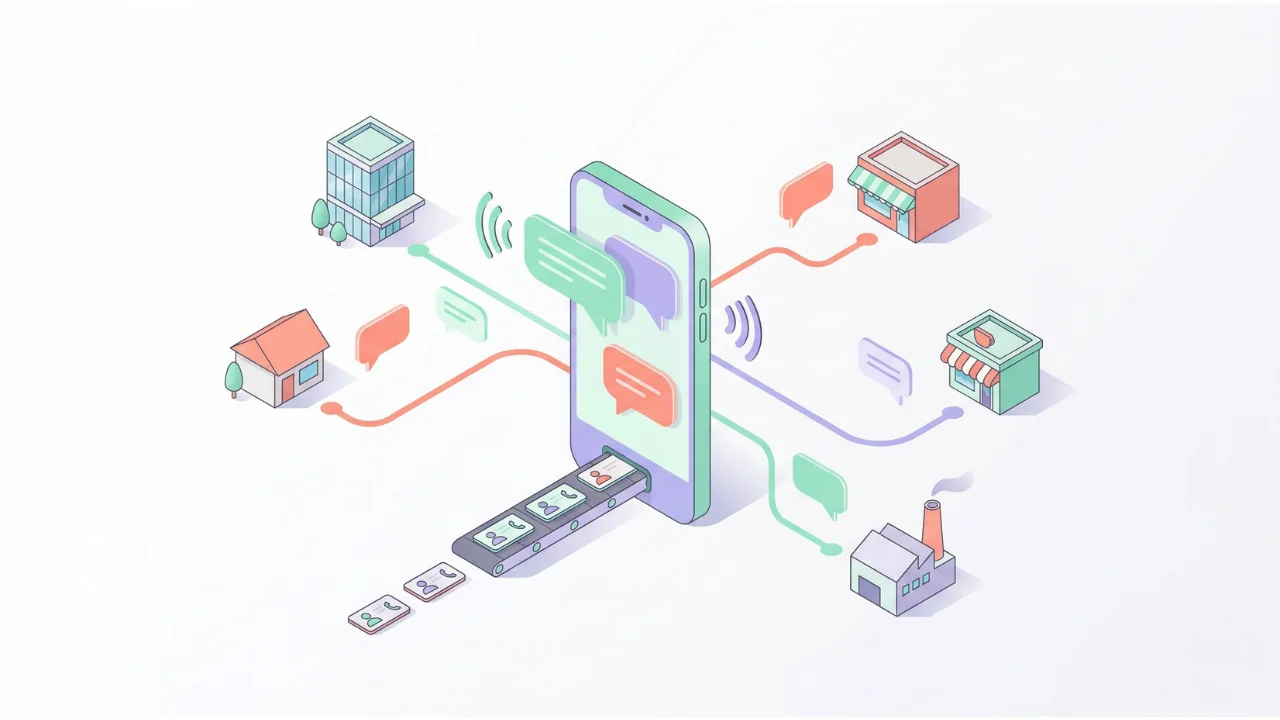
AI Cold Calling: How AI Phone Agents Are Replacing Manual Dialers
Table of Contents
AI cold calling is transforming the way businesses approach outbound sales. Instead of hiring large teams of human agents to manually dial hundreds of numbers per day, companies are deploying AI phone agents that can make thousands of calls simultaneously — with consistent messaging, zero fatigue, and detailed analytics on every conversation.
In this guide, we break down how AI cold calling works, why it is replacing traditional manual dialers, and how you can build your own AI cold calling agent using a telephony API.
What Is AI Cold Calling?
AI cold calling uses artificial intelligence to automate outbound phone calls. An AI phone agent dials a prospect, delivers a scripted or dynamic pitch using natural-sounding text-to-speech, listens to the prospect's responses with speech recognition, and adapts the conversation in real time using a large language model (LLM).
Unlike robocalls or pre-recorded messages, modern AI cold callers hold genuine two-way conversations. They can answer questions, handle objections, qualify leads, and even schedule follow-up appointments — all without human intervention.
Key Components of an AI Cold Caller
- Telephony infrastructure — the phone line, number provisioning, and call routing
- Speech-to-text (STT) — converts the prospect's voice into text the AI can process
- Large language model (LLM) — processes the conversation and generates intelligent responses
- Text-to-speech (TTS) — converts the AI's text response into natural-sounding voice
- Call management — recording, transcription, analytics, and CRM integration
Why AI Cold Calling Is Replacing Manual Dialers
Traditional cold calling has long been one of the most labor-intensive activities in sales. Here is why AI is changing that.
1. Scale Without Headcount
A single human sales rep can make 50 to 80 calls per day. An AI cold calling system can make thousands. With API-driven outbound calling, you can programmatically initiate calls to your entire prospect list and let the AI handle the conversation.
This does not mean replacing your sales team. It means letting AI handle the initial outreach and qualification, so your human reps only spend time on warm, qualified leads.
2. Consistent Messaging Every Time
Human agents have off days. They forget key talking points, rush through scripts, or get flustered by objections. An AI phone agent delivers the same quality pitch on call number one and call number one thousand. You define the system prompt, the tone, and the guardrails — the AI executes consistently.
3. 24/7 Availability
AI cold callers do not take breaks, call in sick, or observe time zones. You can schedule campaigns to reach prospects during their local business hours across any region, running outbound calls around the clock.
4. Real-Time Data and Analytics
Every AI call generates structured data: full transcripts, call duration, sentiment signals, and outcome classification. This gives sales managers immediate visibility into campaign performance without relying on manual call logging.
5. Lower Cost Per Call
The economics are straightforward. Traditional cold calling costs include salaries, training, management overhead, and turnover. AI cold calling costs are per-minute telephony fees plus AI model usage — often a fraction of the fully loaded cost of a human caller.
How AI Cold Calling Works: A Technical Overview
If you are a developer or technical founder looking to build an AI cold calling system, here is what the architecture looks like.
Step 1: Get a Phone Number
You need a real phone number that your AI agent can call from. Using a telephony API like BubblyPhone Agents, you can purchase local or toll-free numbers in over 40 countries via a single API call.
POST /api/v1/phone-numbers
{
  "country_code": "US",
  "area_code": "312"
}
This gives your AI agent a real caller ID that prospects can see and call back.
Step 2: Configure Your AI Agent
Define how your AI should behave during calls. This includes the system prompt (instructions), the AI model to use, the voice, and any tools the AI can invoke mid-call.
PATCH /api/v1/phone-numbers/{id}
{
  "mode": "streaming",
  "system_prompt": "You are a sales development rep for Acme Corp. Your goal is to qualify the prospect and book a demo. Be friendly, concise, and professional. If they are interested, use the book_demo tool.",
  "model_id": 1,
  "voice": "Kore",
  "tools": [
    {
      "name": "book_demo",
      "description": "Book a product demo with the prospect",
      "parameters": {
        "date": { "type": "string" },
        "time": { "type": "string" },
        "email": { "type": "string" }
      }
    }
  ],
  "tool_webhook_url": "https://your-api.com/tools"
}
Step 3: Initiate Outbound Calls
With your number configured, you can start making calls programmatically.
POST /api/v1/calls
{
  "from": "+13125550100",
  "to": "+14155550200",
  "mode": "streaming",
  "system_prompt": "You are calling on behalf of Acme Corp..."
}
When the prospect picks up, the AI immediately begins the conversation. The audio streams in real time between the phone network and the AI model, achieving sub-second latency — the prospect hears a natural, responsive voice.
Step 4: Handle Mid-Call Actions
During the call, the AI can invoke tools you have defined. For example, if the prospect says "Sure, let's book a demo for Thursday," the AI calls the book_demo tool, your webhook processes it, and the AI confirms the booking in the same conversation.
You can also inject context mid-call if needed:
POST /api/v1/calls/{id}/context
{
  "context": "The prospect's company just raised Series B funding last week."
}
Step 5: Analyze Results
After each call, retrieve the full transcript and recording for analysis.
GET /api/v1/calls/{id}/transcript
GET /api/v1/calls/{id}/recording
Use this data to refine your AI's system prompt, identify common objections, and measure conversion rates across campaigns.
AI Cold Calling vs. Traditional Cold Calling
Best Practices for AI Cold Calling Campaigns
Write a Clear, Focused System Prompt
Your AI agent is only as good as its instructions. Define the goal (qualify leads, book demos, gather feedback), the tone (professional, friendly, concise), and the guardrails (what not to discuss, when to transfer to a human).
Start with a Small Batch
Do not launch with 10,000 calls on day one. Start with 50 to 100 calls, review the transcripts, identify where the AI stumbles, and refine the prompt before scaling.
Respect Regulations
AI cold calling must comply with local telemarketing laws including the Telephone Consumer Protection Act (TCPA) in the US, GDPR in Europe, and equivalent regulations in other regions. Always ensure you have proper consent and honor do-not-call lists.
Use Tool Calling for Actions
Do not just have your AI talk — give it tools to act. Book appointments, send follow-up emails, update your CRM, or transfer to a human agent when the conversation warrants it.
Monitor and Iterate
Review call transcripts regularly. Look for patterns in prospect objections, questions the AI cannot answer well, and drop-off points. Update your system prompt based on real data.
Use Cases for AI Cold Calling
Outbound Sales Qualification
The most common use case. AI calls prospects from a list, delivers a brief pitch, qualifies interest, and books meetings for human sales reps.
Appointment Reminders and Confirmations
Healthcare clinics, service businesses, and SaaS companies use AI callers to confirm upcoming appointments, reducing no-show rates.
Customer Re-engagement
Reach out to churned customers or inactive accounts with personalized messages. The AI can reference their account history and offer relevant incentives.
Market Research and Surveys
Conduct phone surveys at scale. The AI asks structured questions, captures responses, and compiles results automatically.
Debt Collection Outreach
Financial services companies use AI callers for initial payment reminder outreach, routing complex cases to human agents.
Getting Started with BubblyPhone Agents
BubblyPhone Agents is a telephony API designed specifically for AI phone agents. It handles the infrastructure — phone numbers, call routing, billing, and recording — so you can focus on building the AI logic.
Here is what makes it a strong choice for AI cold calling:
- Two integration modes: Use streaming mode for sub-second latency real-time calls, or webhook mode for full programmatic control
- Bring Your Own AI (BYOA): Use any LLM — GPT, Gemini, Claude, or your own fine-tuned model
- Bring Your Own Key (BYOK): Use your own API keys for AI models and skip platform model charges
- Tool calling: Your AI can invoke functions mid-call (book meetings, look up data, transfer calls)
- Transparent pricing: Pay-as-you-go at $0.05/min outbound, no contracts or minimums
- Full transcripts and recordings: Every call is automatically transcribed and recorded for analysis
- Phone numbers in 40+ countries: Purchase local numbers via API for a familiar caller ID
Explore the API documentation to see all available endpoints, or sign up and make your first AI cold call in minutes.
Frequently Asked Questions
Is AI cold calling legal?
AI cold calling is legal in most jurisdictions, but you must comply with telemarketing regulations. In the US, the TCPA requires consent for automated calls to mobile phones and prohibits calls to numbers on the National Do Not Call Registry. Always consult legal counsel for your specific use case and region.
How much does AI cold calling cost?
Costs depend on your telephony provider and AI model. With BubblyPhone Agents, outbound calls cost $0.05 per minute plus AI model usage (as low as $0.04/min for Gemini). A typical 2-minute cold call costs roughly $0.18 total — far less than the $5 to $15 fully loaded cost of a human caller.
Can an AI cold caller handle objections?
Yes. Modern LLMs are trained on vast conversational data and can handle common objections naturally. You can also include specific objection-handling instructions in your system prompt. For complex objections, configure the AI to transfer the call to a human rep.
What is the difference between AI cold calling and robocalls?
Robocalls play pre-recorded messages with no ability to respond to the listener. AI cold callers hold real two-way conversations, listening and responding dynamically. The experience for the prospect is much closer to speaking with a human.
How do I measure AI cold calling success?
Track metrics like connection rate (calls answered vs. attempted), qualification rate (leads qualified vs. calls answered), booking rate (demos booked vs. leads qualified), and average call duration. BubblyPhone Agents provides full call transcripts and metadata via API for building your own analytics.
Conclusion
AI cold calling is not a futuristic concept — it is a practical tool that businesses are using today to scale outbound sales, reduce costs, and improve consistency. With the right telephony API and AI model, you can build an AI cold calling agent that qualifies leads, books meetings, and works around the clock.
Ready to build your own AI cold caller? Get started with BubblyPhone Agents — purchase a number, configure your AI, and make your first outbound call in minutes.
Ready to build your AI phone agent?
Connect your own AI to real phone calls. Get started in minutes.
Related Articles

 7 min
7 minSierra AI Alternative: When You Want the API, Not the Enterprise Contract
Sierra is a well-funded enterprise customer service AI with outcome-based pricing starting around $150K/year. For teams that want a phone agent without a six-figure contract, here is the alternative.

 6 min
6 minKore.ai Alternative: When to Pick Something Lighter
Kore.ai serves large enterprises with heavy compliance needs. For most teams, a lighter alternative is a better fit. Here is how to decide.

 5 min
5 minAir.ai Alternative: Developer-First Voice AI Without the Pricing Mystery
Looking for an Air.ai alternative with transparent pricing and a developer-first workflow? A practical comparison of what each platform offers and who fits where.

 6 min
6 minBland AI Alternative: When a Simpler, Cheaper Developer API Wins
Bland AI is a strong voice agent platform, but tiered per-minute pricing and $299/$499 plan floors push developers to look for a simpler alternative. An honest comparison.